Do you know that a confident smile is more than looks? It is the mirror of your overall health, comfort and self-assurance. If you want to improve your smile, you might be wondering which type of brace can fit into your lifestyle, pocket, and goal. The key question is should you go for clear aligners or for fixed braces. Typically, both treatment options straighten teeth, resolve bite problems, and develop lasting oral health outcomes. The use of the right tools, comfort level, and appearance makes the difference. The perfect choice is defined by your personal orthodontic needs. This article helps you explore two different types of options with distinct qualities for a need-specific decision.
Understanding the Difference
Both are braces, but with different characteristics and benefits. Let’s understand the difference to make a clear decision with your professional orthodontist.
Invisalign
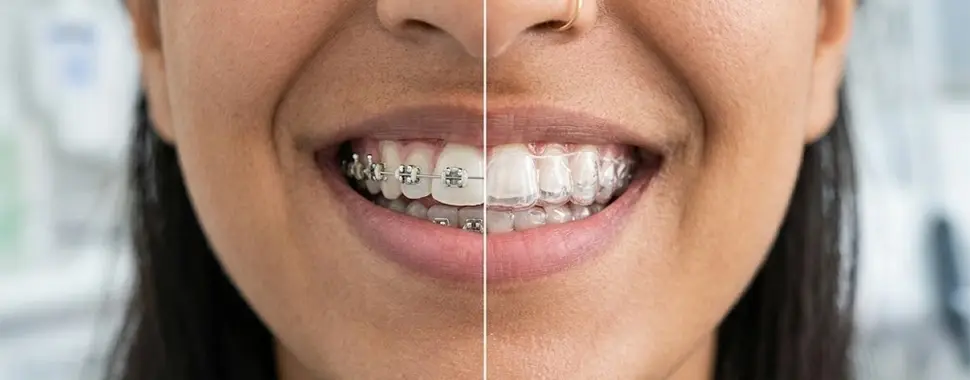
Invisalign treatment provides clear aligners made of seamless plastic, and each tray allows for balanced pressure for teeth mobility into the desired position. If you require mild to moderate teeth alignment, the Invisalign aligners are removable and specifically designed for the gradual straightening of teeth. These aligners are virtually invisible, and as the clear aligner term defines itself, it offers personalised trays as a perfect substitute for fixed braces. In a customised treatment plan, patients feel more comfortable switching to new aligners for more desired outcomes.
Traditional Braces
Fixed braces are made of metal brackets and well-curved wires to guide tooth movement. Conventional braces are an old school of treatment method to correct various dental problems. Dental braces are commonly preferred for a variety of orthodontic problems, especially in complex situations where precise teeth straightening and movement are required. These brackets are connected with wires and elastics. They strongly stick to the teeth to manage severe misalignment. Patients with particular dental issues can experience this option. There is no question about it, conventional braces are perfect to deal with intricate orthodontic issues and misalignment problems.
In a quick snapshot, Invisalign is one of the types of clear aligners. This is also known as invisible braces, typically effective for:
- Crooked teeth
- More spaced teeth
- Severely misaligned teeth
These clear aligners come in sets and are worn in sequence. Whereas braces come in brackets and are visible as well. Don’t fret. There are certain useful materials and techniques to make them less visible, such as tooth colored brackets or wearing braces directly from behind the teeth. Both the treatment options normally require 12 to 24 months for expected results.
Benefits of Invisalign Aligners
- Almost invisible in routine life.
- Smoothly removable aligners.
- Make brushing and eating simple.
- Reduced gum irritation due to smooth plastic.
- Fewer office visits than braces.
- Appealing to self-conscious adults.
- The Invisalign treatment process involves 3D scans for a digital treatment plan.
Benefits of Traditional Braces
- Severe misalignment is easy to handle.
- Normally, a fixed requirement requires no patient compliance.
- Proven results for adult patients.
- Choice options: lingual braces, metal braces, and ceramic braces.
- The treatment process largely depends on in-office adjustments.
Factors Influence Pricing
- Intricacy of orthodontic problems.
- Treatment duration from start to end.
- What is the geographic spot?
- Dental insurance plan coverage.
Explore the Lifestyle Considerations
Knowing the role of orthodontic aligners and traditional braces in lifestyle is crucial to making the right final decision. Let’s explore the difference in lifestyle matters.
- Drinking and Eating
There is no restriction in aligners case, as they are smoothly removable. Whereas, you need to avoid sticky types of food as they can impair the wires and brackets of braces.
- Oral Hygiene
No worries for adults using Invisalign because the trays are easy to remove before brushing or flossing for the maintenance of oral hygiene. Braces increase the risk of tartar and plaque buildup, but special care and oral hygiene can make it a good choice.
Which One is Better for Adults?
Whether to go for an Invisalign or braces, the decision entirely depends on your orthodontic needs, budget and daily lifestyle. Both treatment options prioritise your comfort, cosmetic orthodontics and a straighter smile.
Before you go deeper into comparison, let’s rest assured, both treatment options offer proven results. Understanding your orthodontic needs is important for making the right decision. This is a handy guide for those who are hanging in the middle, whether to choose Invisalign or braces. Let’s know your needs and preferences first before you choose the treatment option.